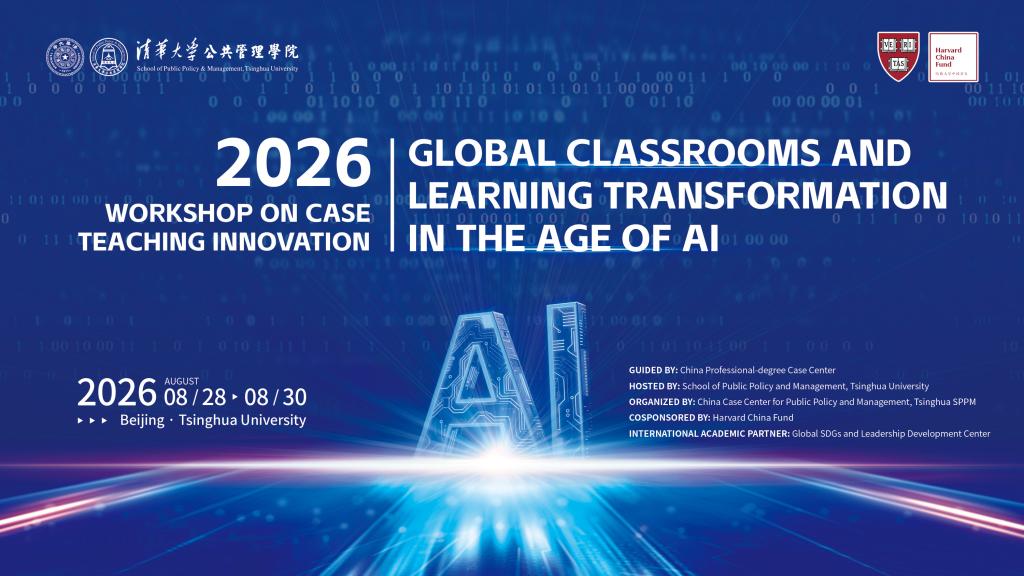
The 2026 Workshop on Case Teaching Innovation: Global Classrooms and Learning Transformation in the Age of AI was held at Tsinghua University from August 28 to 30.
The event was the first fully English-language workshop on case teaching organized by Tsinghua University’s School of Public Policy and Management (Tsinghua SPPM) for educators from China and overseas. The workshop focused on case teaching, global classrooms and educational innovation in the age of artificial intelligence. It brought together 31 faculty members and education professionals from 19 universities and institutions in China, Romania, Vietnam and Malaysia.
The event was hosted by Tsinghua SPPM and organized by the China Case Center for Public Policy and Management (CCCPPM), with support from the China Professional Degree Case Center, the Harvard China Fund and the Global SDGs and Leadership Development Center.
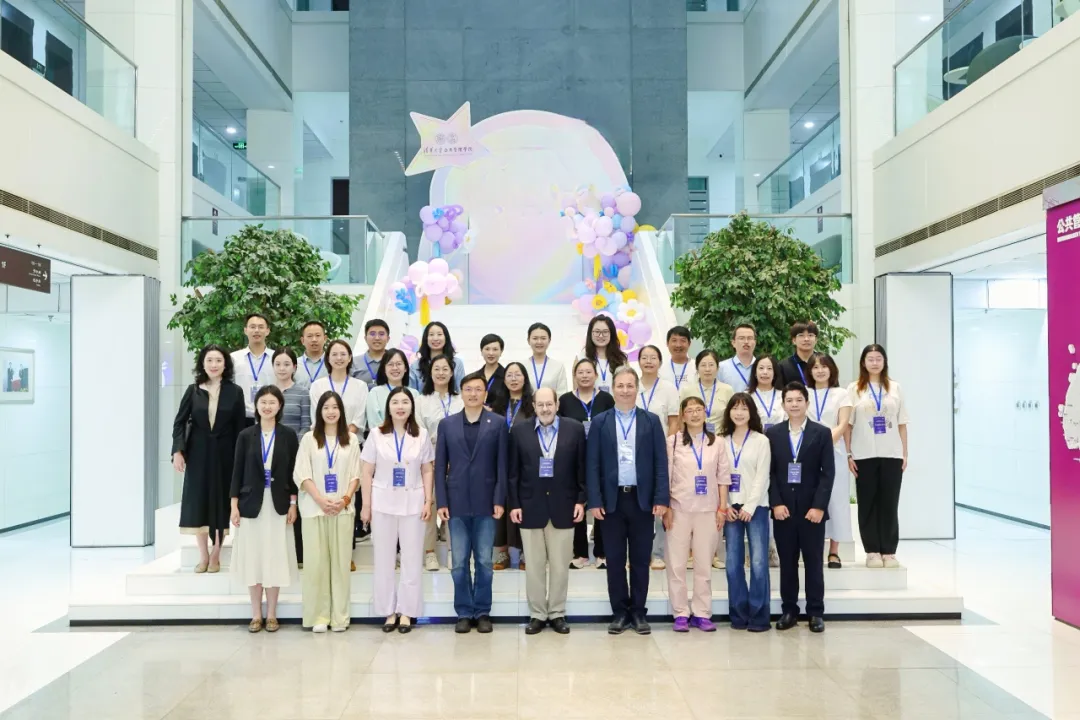
Group Photo
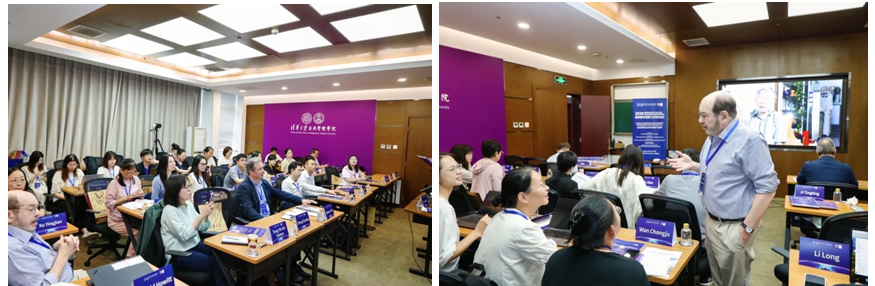
Workshop in Session
Connecting Theory with Practice
Zhu Xufeng, Professor and Dean of Tsinghua SPPM, delivered the opening address on August 28.
Zhu welcomed the participants on behalf of the School. He noted that generative AI is reshaping higher education and that public administration education must place greater emphasis on critical thinking and the ability to assess complex real-world situations. Case teaching, he said, provides an important bridge between classroom learning and governance practice. Since establishing the China Case Center for Public Policy and Management in 2004, Tsinghua SPPM has continued to advance case development, teaching, and research. He expressed the hope that the workshop would promote exchange among faculty from different countries and institutions and contribute to innovation in public administration education.
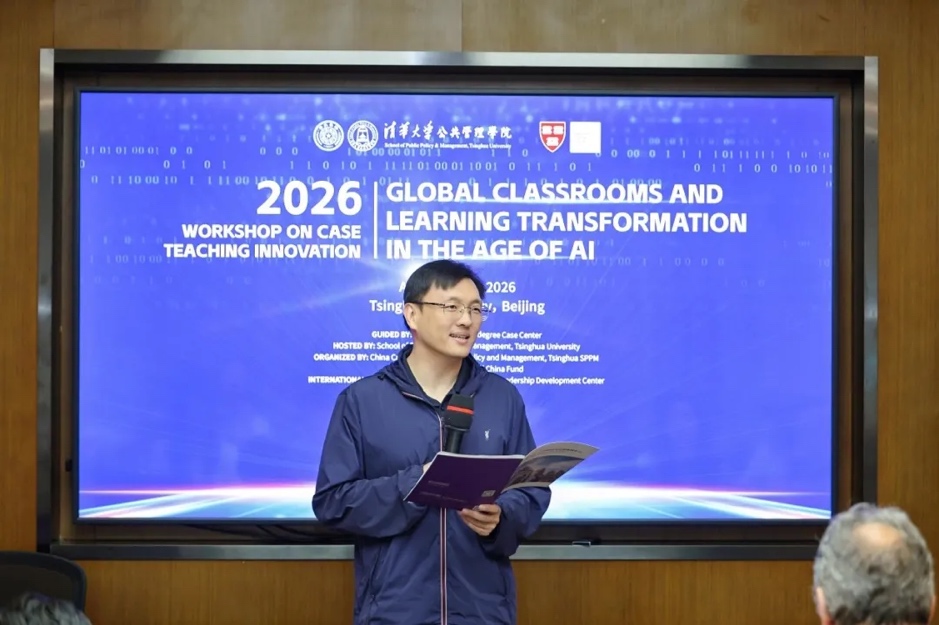
Zhu Xufeng delivers the opening remarks
From Classroom Design to Case Development
As the core teaching component of the workshop, Dr. Arnold Howitt, Founding and Co-Director of the Program on Crisis Leadership at Harvard Kennedy School, led three half-day sessions on the fundamentals of case teaching, the role of the instructor, classroom design, and case development.
Howitt began by comparing traditional lectures with interactive teaching and discussing the characteristics of adult learning. Through case discussion, Socratic questioning, role-playing, and examples such as the Columbia space shuttle disaster, he showed how case teaching can engage students in analyzing difficult decisions under uncertainty. He emphasized that effective teaching cases rarely offer simple answers; instead, they create space for analysis, judgment, and debate through competing considerations, choices, and ambiguity.
Focusing on the instructor’s role, Howitt used cases including The Forest Service and Transitional Fires to demonstrate how a case session can be designed around learning objectives, core questions, classroom prompts, discussion facilitation, and debriefing. He stressed that the instructor’s role is not to provide answers directly, but to structure questions and discussion in ways that help students draw on their own knowledge and experience to develop informed judgments.
In the case development sessions, Howitt introduced key steps including topic selection, evidence collection, interviews, narrative design, and teaching-note preparation. Drawing on both successful and less successful cases, he discussed how to identify decision points that generate productive tension and discussion. Throughout the workshop, he also led debriefs on locally grounded case development, challenges facing younger faculty, cross-cultural classroom adaptation, and the implications of AI for case teaching, linking teaching demonstrations and methodological guidance with participants’ own classroom practice.
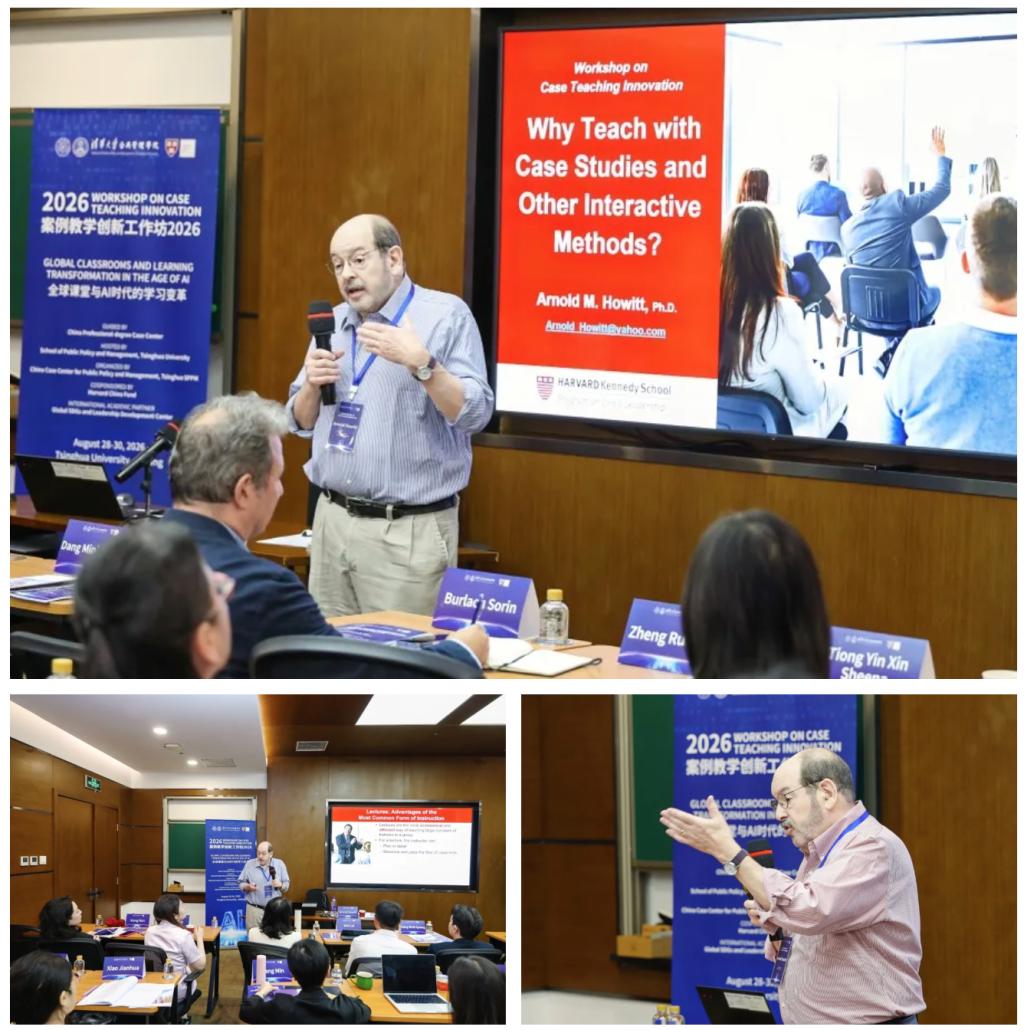
Arnold Howitt leads a session
Exploring New Teaching Method
Faculty members from Tsinghua SPPM shared a range of teaching practices and perspectives on how AI is reshaping education.
Lu Xiaoli, Associate Professor and Executive Director of Tsinghua SPPM’s Behavior and Data Science Lab, spoke on “Scenario-Based Simulation in MPA/IMPA Education: Teaching Practice and Reflection.” He introduced three key components of simulation-based teaching—scenario design, task design, and debriefing and assessment—and illustrated their application through exercises involving decision-making bias, nonverbal communication, leadership directives, eye-tracking, and cross-departmental strategy development and negotiation. He noted that scenario-based simulations can recreate decision-making environments close to real-world governance settings and strengthen students’ ability to analyze and respond to complex problems. At the same time, the field still faces technical challenges, including multimodal data synchronization and the interpretation of decision-making logic in specific domains. Further progress, he argued, will require more robust competency assessment frameworks and stronger instructional support teams.
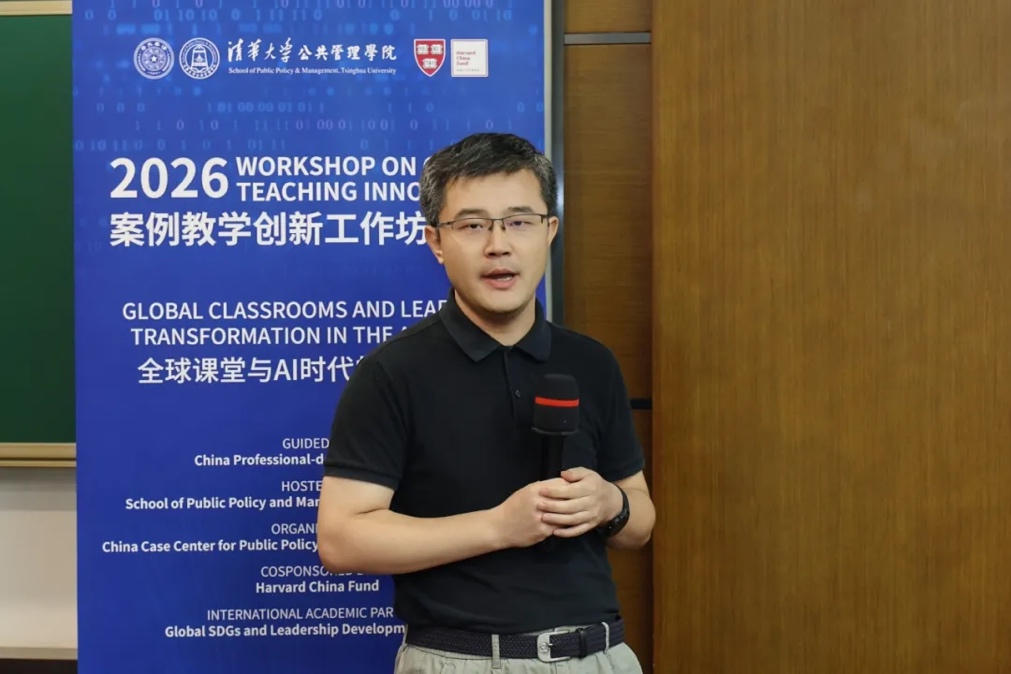
Lu Xiaoli presents during the workshop
Xie Mengyu, English Case Coordinator at the China Case Center for Public Policy and Management (CCCPPM), reviewed the Center’s development over the past two decades and introduced its work in case development, review, publication, classroom use, and dissemination. Drawing on the Center’s case database, case competitions, faculty training, and international partnerships, she outlined the full process through which cases move from field research to classroom use and continued refinement. She emphasized that the Center not only brings together case resources, but also uses standardized workflows, structured programs, and collaborative networks to transform practical knowledge into teachable and shareable resources that can be continuously enriched.
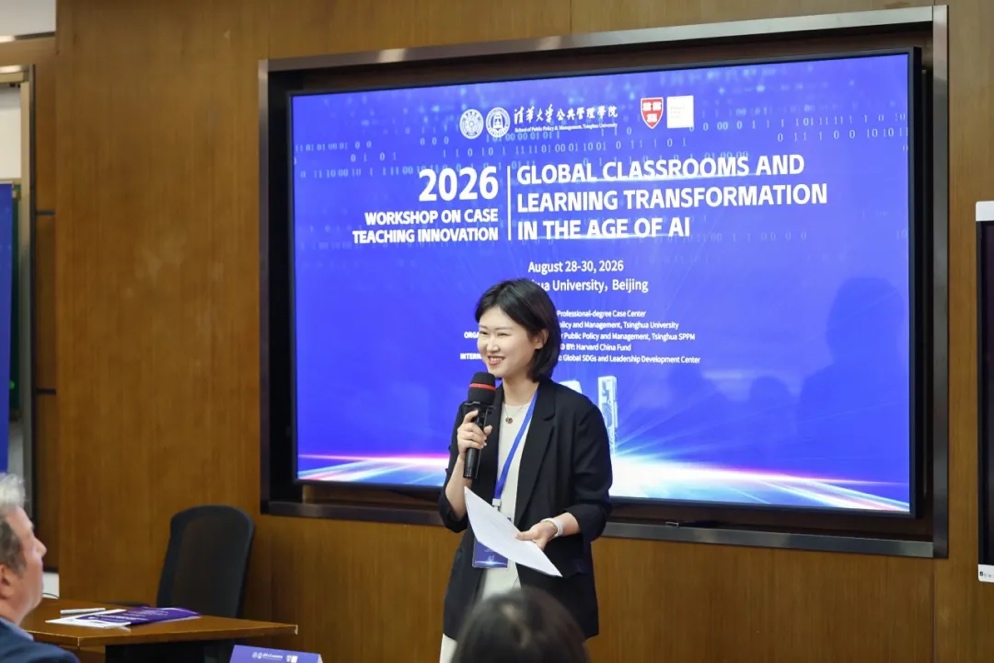
Xie Mengyu presents during the workshop
Gao Yuning, Associate Professor and Deputy Dean of Tsinghua SPPM, presented on “Exploration and Practice in Graduate Education at Tsinghua SPPM.” He introduced the development of the School’s multi-tiered graduate education system and the challenges it currently faces. In response to changes in education policy and the impact of artificial intelligence on student learning, he discussed the School’s efforts in curriculum development, student development, and AI-enabled teaching. He also shared initiatives such as building a public administration knowledge graph and developing discipline-specific AI engines, illustrating how AI can support public administration education and help reshape teaching models.
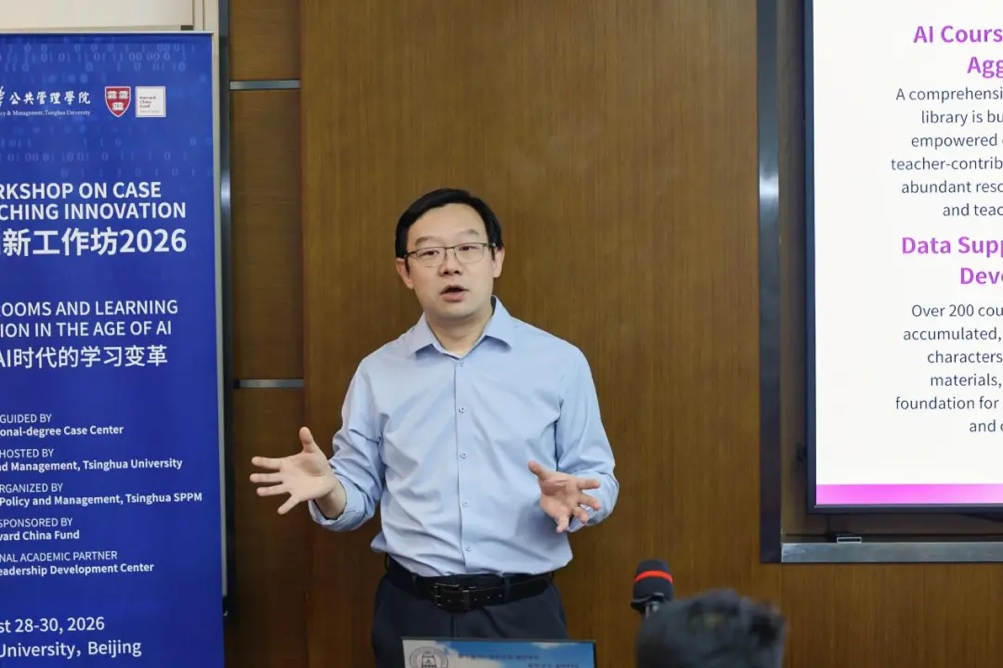
Gao Yuning presents during the workshop
Dai Yixin, Professor at Tsinghua SPPM, discussed case teaching in the course Public Policy Analysis. Starting from learning objectives and course design, she explained how cases of different types and lengths can serve different instructional purposes. Using “Defending Dujiangyan” and other cases, she demonstrated approaches to case selection, discussion design, and classroom implementation. She noted that cases can both place concepts in concrete contexts and provide opportunities for students to apply what they have learned. Cases may be developed specifically for teaching or adapted from academic research, news reports, and other sources, but their selection and use should always be guided by clearly defined learning objectives.
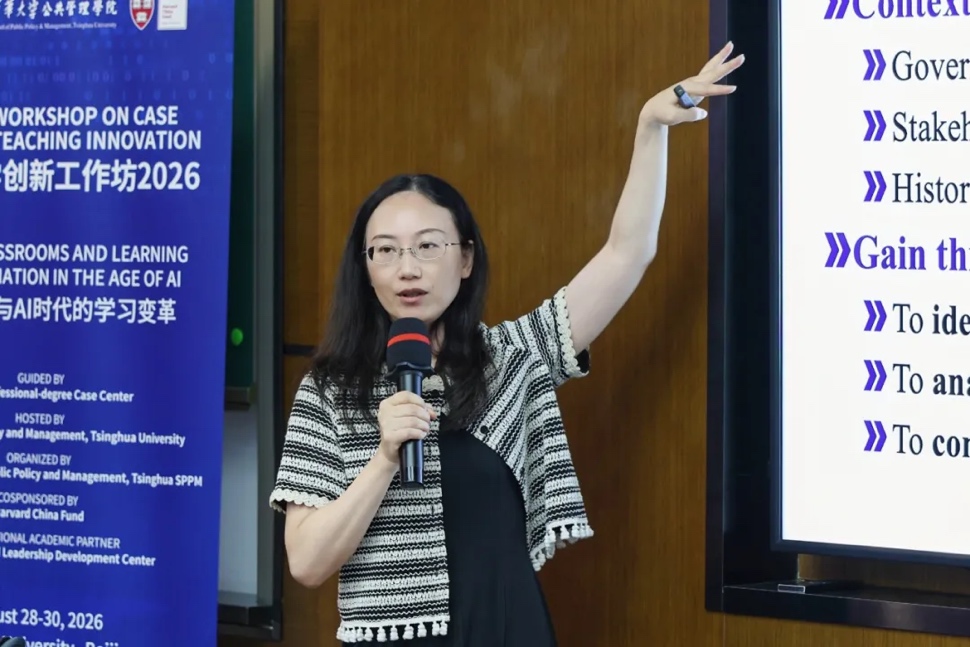
Dai Yixin presents during the workshop
Mu Ling, Assistant Dean of Tsinghua SPPM and Director of CCCPPM, led an exchange with participating faculty on practical issues in case development and teaching. The discussion focused in particular on the new challenges posed by generative AI to teaching, student learning, and classroom participation. Drawing on practices from different institutions, participants also exchanged views on the organization, implementation, and future development of case teaching.
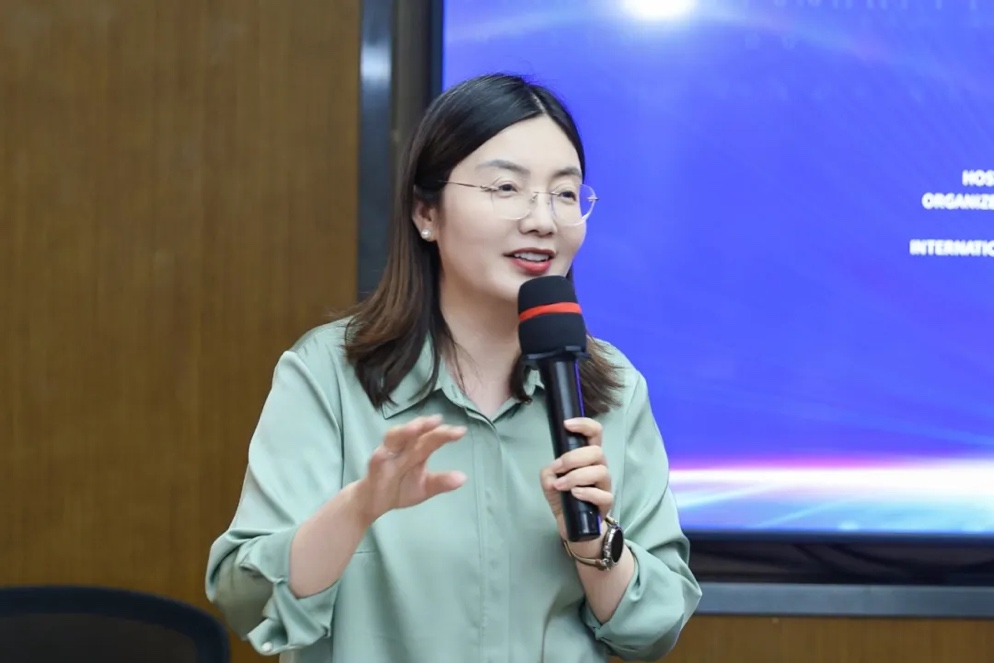
Mu Ling leads the discussion
Zhang Fang, Associate Professor at Tsinghua SPPM, spoke on “Intelligent Society and Governance: Origins and Characteristics.” She examined the emergence and evolution of an intelligent society through the dimensions of knowledge production, trust mechanisms, and structures of authority. She noted that generative AI is changing how knowledge is produced and verified, while platform ratings and algorithmic recommendations are reshaping social trust. At the same time, knowledge-producing actors, digital platforms, and actors with strong network influence are reshaping traditional structures of authority. She characterized an intelligent society as one marked by abundant information, immediate feedback, cognitive reshaping, changing organizational forms, and reconfigured power relations, and argued that governance must move beyond a purely instrumental view of technology and pursue broader innovation in governance.
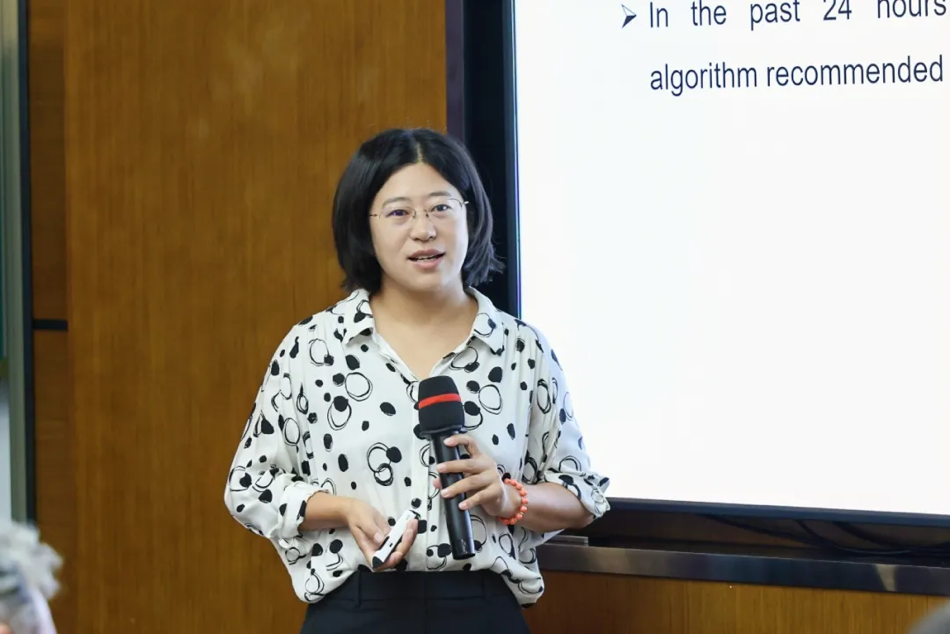
Zhang Fang presents during the workshop
Zhong Wei, Associate Professor and Deputy Dean of Tsinghua SPPM, presented on “Understanding Governance through Artificial Intelligence: A Data-Intensive Approach to Case Analysis.” Drawing on tweets posted by U.S. governors as part of their crisis communication during the first half of 2020, she explained how advances in AI are shifting cases in public governance from data-scarce to data-intensive, making it possible to process large volumes of data, track governance processes over time, and identify complex patterns. She further argued that data-intensive cases can transform cases from “stories” into analyzable datasets, opening new possibilities for innovation in case teaching in the AI era. At the same time, she stressed that AI cannot replace the value judgments and analytical perspectives provided by theory, and that theory and method must remain equally important.
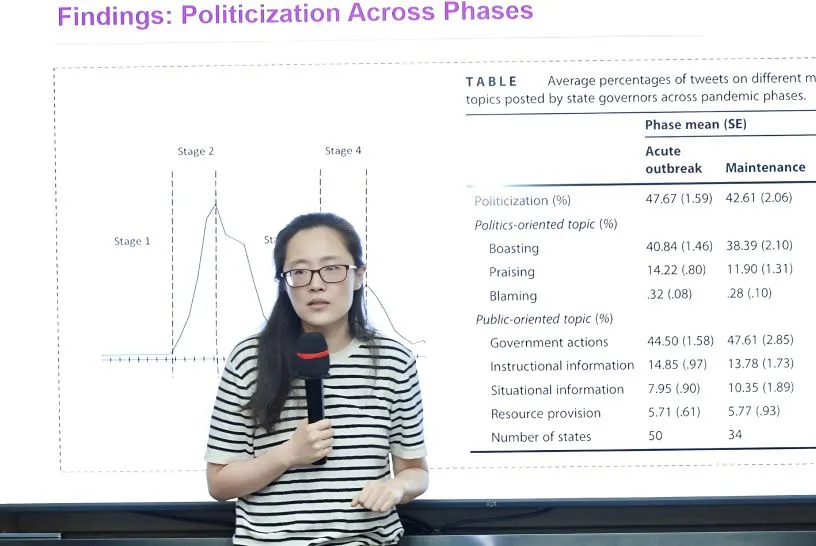
Zhong Wei presents during the workshop
Yin Chengzhi, Associate Professor and Deputy Party Secretary of Tsinghua SPPM, spoke on “The Use of Role-Playing in Case Teaching: The Liang–Chen Plan as an Example.” Using the 1950 Liang–Chen Plan for Beijing’s urban planning as a case, he explained how role-playing can be designed and implemented through the stages of preparation, enactment, and reflection. He noted that role-playing allows students to step into specific roles and engage in active learning, while developing empathy, decision-making, and negotiation skills. Effective role-playing, he emphasized, requires clear learning objectives, realistic scenarios, and appropriate rules. Assessment should also place particular emphasis on the learning process and students’ reflection.
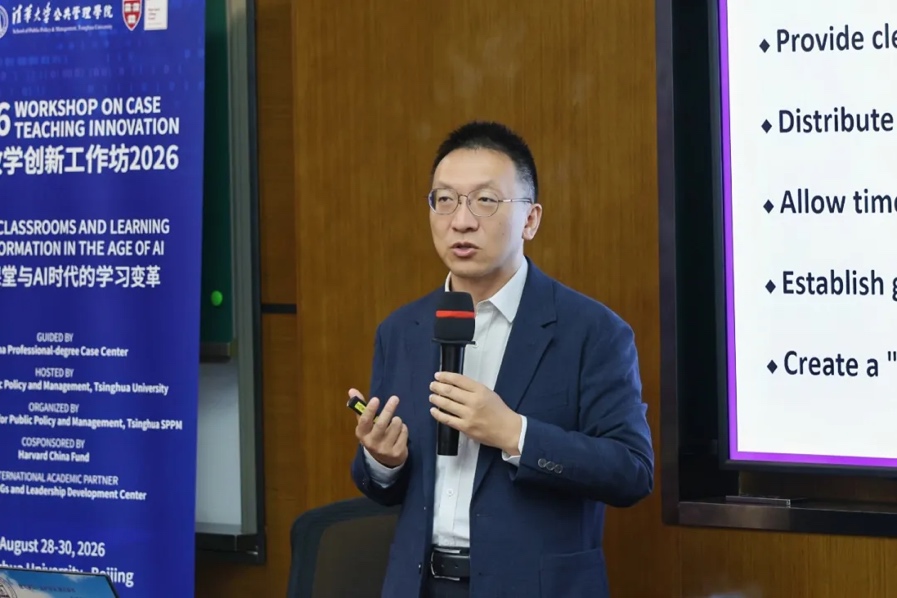
Yin Chengzhi presents during the workshop
Building a Global Community for Case-Based Learning
The workshop concluded on August 30. Gao Yuning delivered remarks on behalf of the School and presented certificates of participation to the attending faculty members. He emphasized that, despite rapid technological change, education should continue to cultivate students’ critical thinking, sound judgment, and ability to address complex real-world challenges. He also highlighted the value of case teaching in connecting theory with practice and expressed the hope that the workshop would encourage further exchange and collaboration among institutions and faculty.
Over three days, the workshop combined lectures, case demonstrations, simulations, role-playing, discussions, and debriefing, while also engaging with emerging topics such as artificial intelligence, global classrooms, and governance in an intelligent society. Participants shared experiences and perspectives, deepening their understanding of case teaching and educational innovation.
Looking ahead, the China Case Center for Public Policy and Management at Tsinghua SPPM will continue to promote exchange and collaboration in case teaching, case development, and educational innovation, and strengthen connections among public administration educators in China and beyond.



 Phone: (86)-10-62788958
 Email: casecenter@tsinghua.edu.cn
 Address: Room 501, School of Public Policy & Management, Tsinghua University,Beijing
